Restoring Biodiversity from the Ground Up
Conventional intensive agriculture often relies on monocropping and heavy chemical use, which degrades soil life, reduces habitat diversity, and weakens ecosystem balance. In contrast, regenerative practices such as crop diversification, intercropping, cover cropping, agroforestry, and crop rotation create heterogeneous landscapes that support diverse plant and animal species.
In saline-prone coastal areas, integrating salt-tolerant crops with legumes and vegetables helps restore ecological balance. Legumes improve soil fertility through biological nitrogen fixation, reducing the need for chemical fertilizers. Agroforestry systems-combining fruit trees, timber species, shrubs, and crops, provide habitats for birds, pollinators, and beneficial insects while generating additional income streams. These diversified systems naturally regulate pests and diseases, enrich soil microorganisms, and strengthen ecological interactions above and below ground. As a result, RA enhances overall farm biodiversity while stabilizing productivity.
Regenerative Agriculture in Action: NABAPALLAB Project
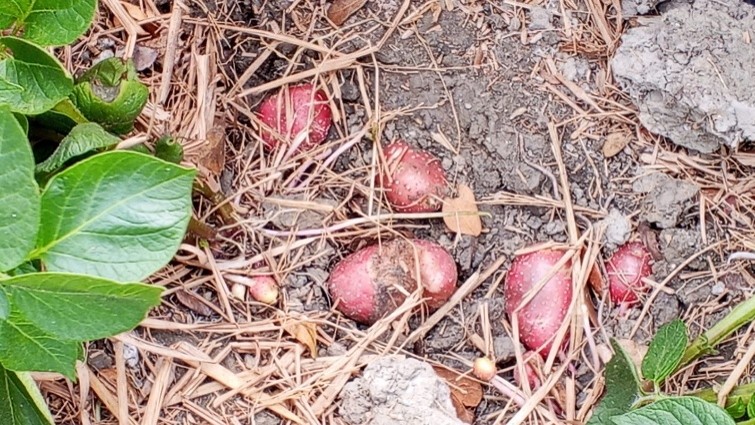
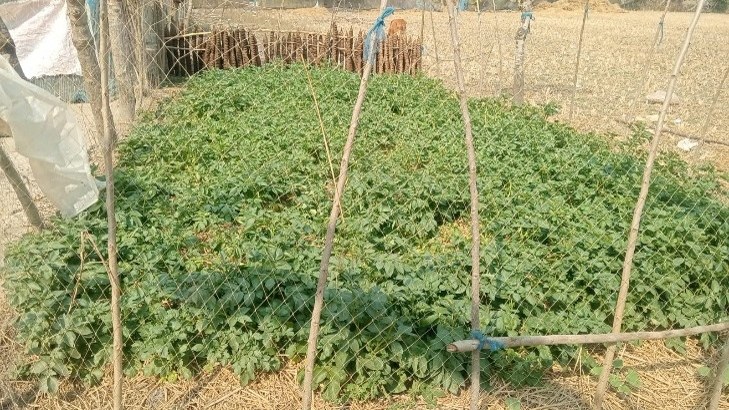
The principles of RA are being piloted in Practical Action’s ‘Nature Based Adaptation towards Prosperous and Adept Lives & Livelihoods in Bangladesh’ (NABAPALLAB) project in southwest coastal Bangladesh. This project demonstrates how regenerative practices can be localized and scaled:
- Minimizing Soil Disturbance: Garlic and potato are cultivated using zero-tillage methods, preserving soil structure and maximizing carbon retention.
- Enhancing Organic Matter: Organic fertilizers are used to restore soil health degraded by erosion and salinity.
- Year-Round Soil Cover: Sweet potato and other cover crops prevent erosion and maintain continuous soil protection during fallow periods.
- Crop Diversification: Crop rotation and relay planting increase productivity and biodiversity while reducing risks.
- Optimized Chemical Use: Emphasis on organic inputs and biological pest control supports beneficial microorganisms and ecosystem health.
Strengthening Climate Resilience
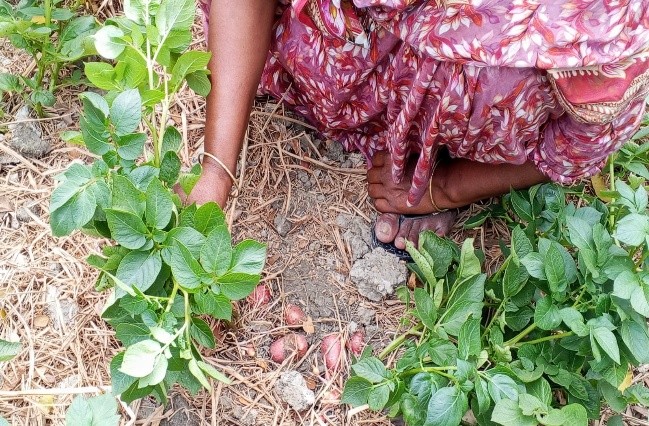
Regenerative agriculture strengthens resilience in multiple, interconnected ways:
Improved Soil Health and Water Retention: Increasing soil organic matter enhances soil structure and water-holding capacity. This enables fields to withstand drought, heavy rainfall, and flooding conditions intensified by climate change.
- Carbon Sequestration: Soils are major carbon sinks, holding more carbon than vegetation and the atmosphere combined. Practices like zero or reduced tillage, permanent soil cover, and cover cropping increase carbon storage while reducing emissions. Through these methods, agriculture can shift from being a greenhouse gas source toward contributing to carbon emission drawdown.
- Adaptation to Salinity: Organic compost, reduced tillage, and deep-rooted crops improve soil structure and reduce salt concentration near the surface. Salt-tolerant crop varieties combined with organic amendments help maintain productivity in saline conditions.
- Reduced External Dependence: By promoting natural fertility and biological pest control, RA lowers reliance on expensive chemical inputs. This reduces production costs and economic vulnerability, particularly for smallholder coastal farmers.
- Governing Soil as a Common Resource
- Beyond techniques, regenerative agriculture represents a shift in mindset—one aligned with the principles of Common Pool Resource management.
- Soil health, water systems, and biodiversity are shared ecological assets. When overused or chemically degraded, their decline affects entire communities. Commons do not inevitably collapse; they can be sustained through collective local stewardship, monitoring, and shared responsibility.
- In coastal Bangladesh, farmer groups adopting regenerative practices embody these principles. Knowledge-sharing, coordinated crop rotations, reduced chemical use, and collective water management protect shared ecosystems.
- Healthy soil becomes a managed commons-restored not by regulation alone, but by cooperation.
Toward a Regenerative Coastal Future
Integrating regenerative agriculture into national strategies aligns with Bangladesh’s long-term ambitions under the Delta Plan 2100. More importantly, it strengthens resilience at the farm level where climate change is felt most acutely.
By restoring soils, enhancing biodiversity, sequestering carbon, and reducing economic vulnerability, regenerative agriculture offers more than improved yields. It rebuilds ecological foundations.
In coastal Bangladesh, resilience will not come from fighting nature, but from farming with it. Through collective stewardship of soil and biodiversity, communities are transforming degraded fields into living commons-productive, diverse, and climate resilient.